
How 3D Photo Crystals Work: The Science Behind Laser Crystal Engraving
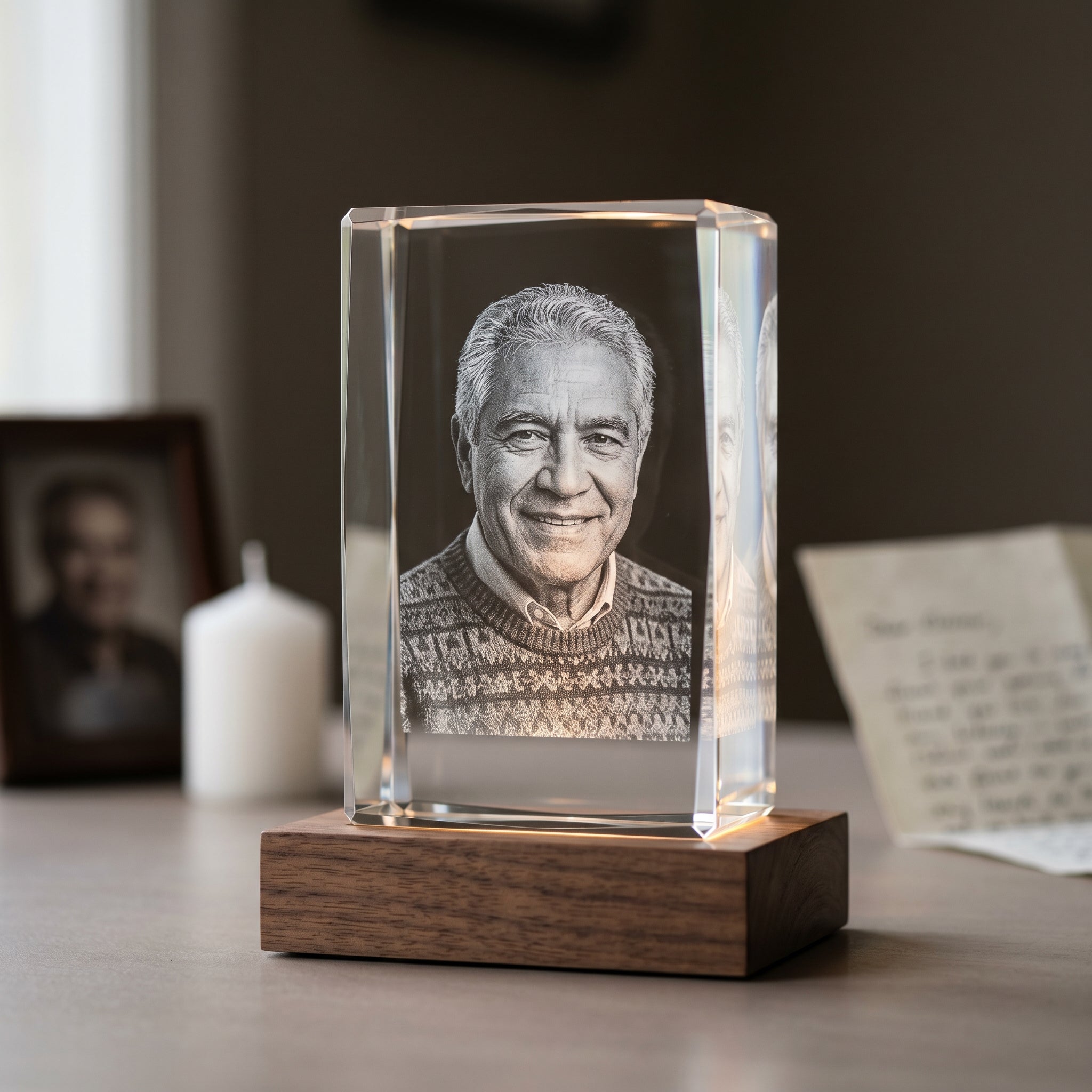
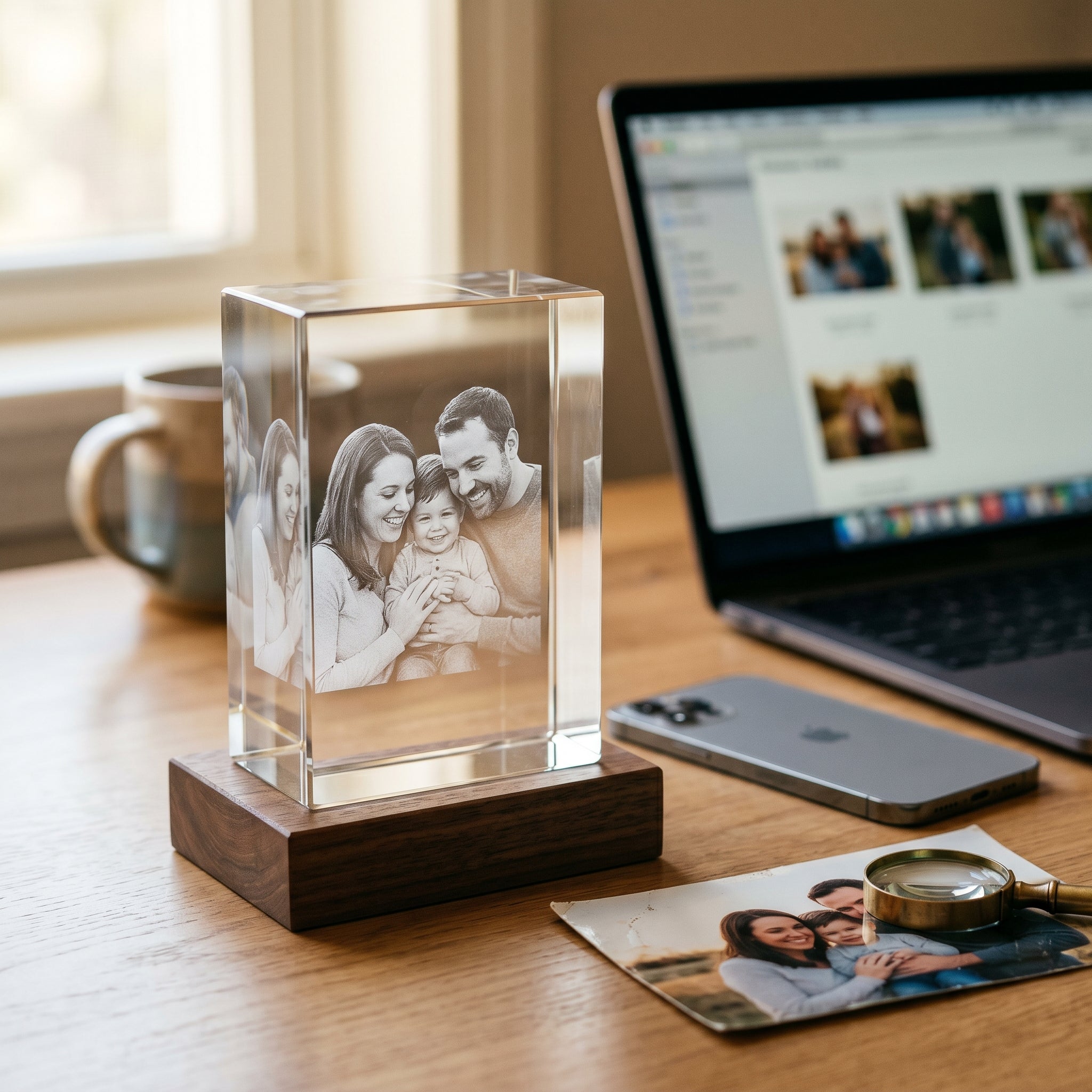
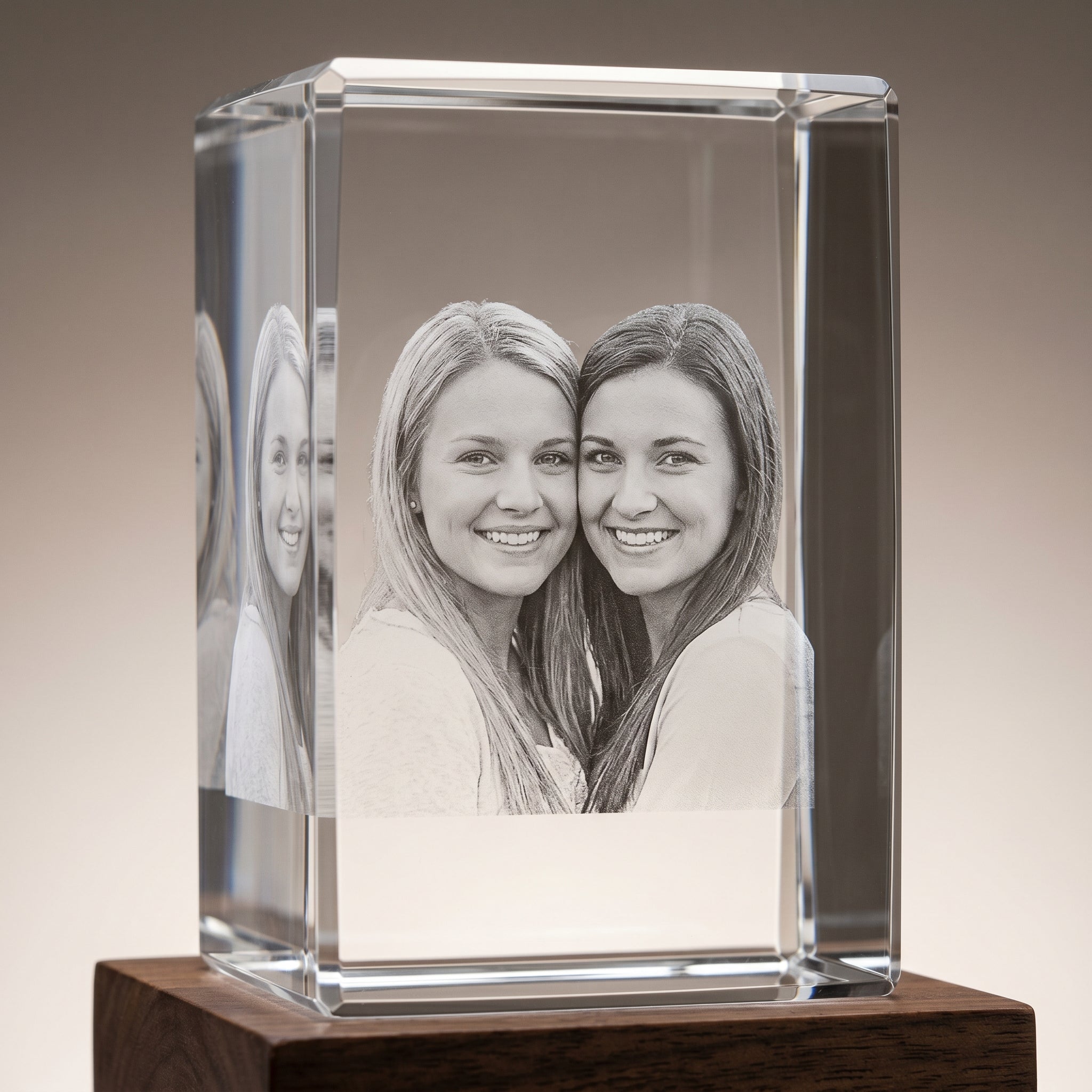
A 3D photo crystal looks almost impossible - a fully three-dimensional portrait suspended inside a solid block of glass, lit from within, hovering in mid-air. No print, no painting, no photograph on glass. The image is literally inside the crystal.
So how does it actually work? The technology is genuinely fascinating, and understanding it makes the gift even more remarkable. Here's exactly how 3D photo crystals are made.
The Short Answer: Subsurface Laser Engraving
A 3D photo crystal is created using a process called subsurface laser engraving (also called laser subsurface crystallography). A specialized laser beam is focused through the surface of a solid glass block and fired at precise points inside the glass - without breaking the surface.
At each focal point, the laser delivers a concentrated pulse of energy that creates a tiny internal fracture called a microfracture or laser dot. These microfractures are invisible to the naked eye but scatter light in a way that creates a visible point of luminosity - essentially a pixel inside the glass.
By firing millions of these microfractures at different depths and positions inside the crystal, the laser builds up a three-dimensional matrix of light-scattering points that, when illuminated, resolves into a photorealistic 3D portrait.
Step by Step: How a 3D Crystal Is Made
Step 1: Photo Processing and 3D Conversion
It begins with your photo. A 2D photograph needs to be converted into a 3D depth map - essentially a model that describes not just what is in the image but how far each element is from the camera.
Specialized software analyzes the photo and generates this depth information. Faces get particular attention: the software identifies the nose as the closest point, the ears as furthest, and maps all the gradations between. The result is a 3D point cloud of the subject - thousands of spatial coordinates representing where every part of the image sits in three-dimensional space.
Step 2: Slicing into Layers
The 3D depth map is then sliced into a series of horizontal layers - similar to how a CT scan works. Each layer represents a plane inside the crystal at a specific depth. The engraving machine will work through these layers one at a time, from the back of the crystal to the front.
Step 3: Laser Engraving
The prepared crystal blank - made from precision optical glass - is mounted in the laser engraving machine. The laser head moves on three axes (X, Y, and Z), positioning itself at each point in the 3D matrix.
At each point, a short laser pulse (typically a picosecond or femtosecond pulse - one trillionth or one quadrillionth of a second) delivers a tiny burst of energy to the focal point inside the glass. The surrounding glass is unaffected because the laser energy only reaches dangerous intensity at the precise focal point. The result is a controlled microfracture: a single, sub-millimeter point of disrupted glass that scatters light.
This process repeats millions of times, building up the 3D matrix layer by layer. Depending on the size and resolution, engraving a single crystal can take anywhere from 20 minutes to several hours.
Step 4: Illumination and the Final Effect
When the engraved crystal is placed on its LED light base, light enters from the base and travels through the crystal. Where the glass is undisturbed, light passes through invisibly. Where the microfractures are - at each laser dot - light scatters and becomes visible as a bright point.
The net effect: the 3D matrix of microfractures lights up as a complete three-dimensional portrait, suspended inside the glass, glowing. The areas with more fractures (the brighter, more detailed parts of the image) appear more luminous. The empty space around the fracture matrix is invisible glass - which is why the portrait appears to float.
Why Optical Glass?
Not all glass works for subsurface laser engraving. The process requires optical grade glass - glass with extremely high purity and uniformity. Bubbles, inclusions, or irregularities in the glass would disrupt the laser's path and introduce errors in the image. They can also create unwanted light scatter that muddies the final portrait.
Beyond Memories uses premium optical glass in all crystal products. The clarity of the glass is part of what makes the final portrait so luminous and precise - it's the same class of glass used in precision optics and scientific instruments.
2D vs. 3D Crystals: What's the Difference?
You may see some crystals marketed as '2D' and others as '3D.' The difference is in how the depth information is used:
- 2D crystals: The image is engraved as a flat layer at a single depth inside the crystal. The result looks like a photograph embedded in glass - flat, like a print.
- 3D crystals: The image is engraved across multiple depths, creating genuine spatial depth. The front of the subject's face sits closer to the viewer; background elements recede. The result is a sculpture-like portrait you can view from multiple angles and see the depth change.
Beyond Memories produces true 3D crystals using full depth-map processing, not 2D flat engravings.
How Long Does a 3D Crystal Last?
A well-made 3D crystal is permanent. The microfractures inside the glass are structural changes to the material - they don't fade, degrade, or require any maintenance. Unlike photos (which yellow and fade), prints (which crack and peel), or canvases (which can crack with temperature changes), a glass crystal in normal indoor conditions will look exactly the same in 100 years as it does today.
The LED light base uses long-lasting LED technology. If the base ever needs to be replaced (after many years of use), the crystal itself is completely unaffected - any compatible LED base will illuminate it just as well.
What Makes a Good Photo for a 3D Crystal?
Because the 3D conversion relies on facial geometry and depth information, the best photos for 3D crystals have:
- Clear face visibility - the subject's face should be clearly visible, not partially obscured
- Good lighting - even, clear lighting helps the depth-mapping software read the facial contours accurately
- High resolution - more pixels means more detail in the final engraving
- Front-facing orientation - photos where the subject faces the camera (rather than a sharp profile) produce the best 3D depth
Photos taken outdoors in natural light often work exceptionally well. Professional portraits are ideal. Casual smartphone photos can work if they're sharp and well-lit.
Frequently Asked Questions
Is the image painted or printed onto the crystal?
No. There is no paint, ink, or surface treatment involved. The image is created entirely by microscopic structural changes inside the glass. This is why 3D crystals are permanent - there's nothing to fade or peel.
Can a 3D crystal be made from any photo?
Most photos can be converted, though the quality of the result depends on the quality of the source photo. Clear, high-resolution photos with good lighting produce the best results. At Beyond Memories, we review every photo before processing and will reach out if we have concerns about image quality.
Does the crystal need to be kept on the light base?
No. The crystal looks beautiful in ordinary ambient light - the microfractures create a subtle three-dimensional effect even without the LED base. The light base simply makes the portrait dramatically more vivid and visible, especially in dim conditions.
Can a 3D crystal break?
Optical glass is durable but not indestructible. A sharp impact or fall can crack or shatter the crystal, just like any glass object. Keep it in a stable location away from edges. The crystal is not a toy.
How is a 3D photo crystal different from a regular photo gift?
A regular photo gift - print, canvas, framed photo - reproduces the image on a surface using ink or dye. A 3D crystal reproduces the image inside solid glass using light. The result is fundamentally different in look, feel, and permanence. There's no analog in traditional photography for the floating, luminous, three-dimensional effect of a laser-engraved crystal.