
Glass Pictures vs 3D Crystal Photos: Which Format Best Preserves Your Memory?
By Beyond Memories Editorial Team · May 10, 2026 · 9 min read
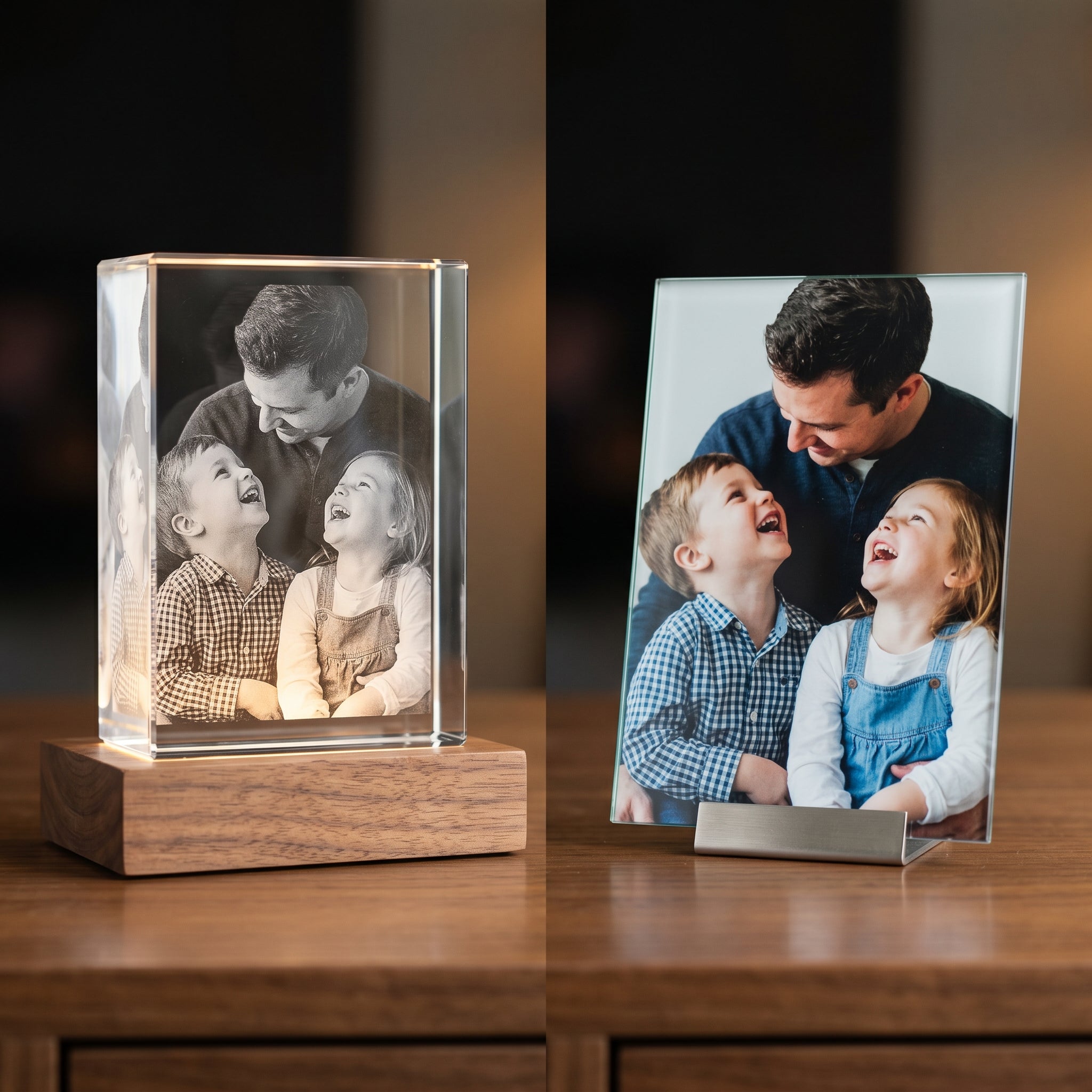
Glass pictures come in three distinct categories: UV-printed glass photos (color image printed on the surface of flat glass), surface-etched glass photos (a rotary engraver carves the image into the front face), and subsurface 3D crystal photos (millions of microscopic etched points laid down inside the volume of optical crystal). Each one looks different, ages differently, and costs differently — and the right choice depends on whether you want a colorful flat print, a frosted line drawing, or a full photographic portrait suspended in three dimensions inside the glass.
This piece compares all three honestly: where each one wins, where each one loses, what they cost, and how they'll look in twenty years. We'll close with a comparison table and a short "choose this one if" guide.
Table of Contents
- Why glass at all?
- Format 1: UV-printed glass photos
- Format 2: Surface-etched glass pictures
- Format 3: Subsurface 3D crystal photos
- Side-by-side comparison
- When to choose which
- Frequently Asked Questions
Why glass at all?
Before comparing the three formats, it's worth naming why people pick glass over canvas, paper, metal, or acrylic in the first place. Glass has three properties that the other photo-gift substrates can't match.
It doesn't yellow. Paper photos shift to a warm sepia within a decade of light exposure. Inkjet prints on cheap canvas crack at the folds. Glass is chemically inert and UV-stable; the substrate itself looks identical at year twenty as it did at year one. (How well the image survives depends on which of the three glass formats you pick — we'll get to that.)
It refracts light. A photo on paper sits flat and dull. A photo in glass catches every angle of light in the room, throws specular highlights off its bevels, and changes appearance through the day. The same image reads differently in morning side-light than in evening lamp-light.
It feels permanent. A glass photo announces itself as a kept object, not a printed reminder. The weight in the hand and the cool touch of the surface communicate something a paper print can't.
Format 1: UV-printed glass photos
The most affordable category. A flatbed UV printer lays down full-color ink directly on the back surface of a flat glass panel, then cures the ink instantly with ultraviolet light. The image is viewed through the glass from the front, which gives the print a glossy, depthless, photo-under-glass look.
What it looks like
Full color. Sharp at typical viewing distance. The image sits exactly at the back surface of the glass — no depth, no float. From the front, it reads like a photo behind a sheet of clear acrylic. The glass surface itself catches reflections from room lighting, which can wash out the image at certain angles.
Pros
- Color. The only one of the three formats that retains full color from the source photo.
- Cheap. A 6×8 inch UV-printed glass photo runs $20–40 at most online photo printers.
- Fast. No 3D modeling step — the printer goes from photo to finished panel in under an hour.
Cons
- UV inks fade. Direct sunlight on a UV-printed glass panel will visibly degrade the colors within 5–10 years — cyan and magenta inks shift first, leaving warm yellow tones.
- The ink layer can scratch. The image is on the back surface, but the substrate is finite — a hard scrape can lift ink.
- No depth perception. The photo sits flat. There's no "floating in glass" effect because the image is literally on a 2D surface.
Best for
Casual gifts, color-critical photos (sunsets, vibrant artwork, brightly-dressed children), and budget-conscious projects where the goal is a photo that looks nice on a shelf for the next 5–10 years.
Format 2: Surface-etched glass pictures
The middle option in age, price, and tactile quality. A CO2 laser or a rotary engraver removes a thin layer from the front face of a flat glass panel, leaving a frosted-white image that reads as a high-contrast monochrome line rendering. The image sits on the surface of the glass; you can feel its texture with a fingertip.

What it looks like
Monochrome. High contrast. Reads more like a stencil or a frosted line drawing than a photograph. Subtle gradient — say, the soft fade from a cheek into shadow — either gets dropped to pure white or compressed into a hard edge. Best results come from photos that already have strong contrast and clean silhouettes (a child against a bright sky, a couple in profile).
Pros
- Permanent. The etching is physically removed from the glass surface; it cannot fade. The image you see at year one is the image at year fifty.
- Tactile. The frosted texture is something you can feel. Some people prefer this physical presence to a smooth printed image.
- Price-reasonable. Surface-etched glass plaques run $30–80 typically.
Cons
- No color. Always white-frost on clear glass. Color photos lose their color.
- Limited gradient. The etcher works in two states — frosted or clear — with limited tonal middle ground. Continuous-tone portraits (close-up faces with subtle skin shading) often render flat.
- Image sits on the front face. No depth — the image is locked to the front surface plane. Looking at it from the side reveals it as a thin frosted layer.
- Surface oils and dust accumulate in the etched grooves over years, slightly dulling the image (cleanable, but a maintenance task).
Best for
High-contrast photographs (silhouettes, profiles, monochrome portraits), inscriptions and text-heavy designs, decorative panels where a softened line-drawing aesthetic is preferred to photo-realism. Read more on the technique in our explainer on laser etching in crystal.
Format 3: Subsurface 3D crystal photos
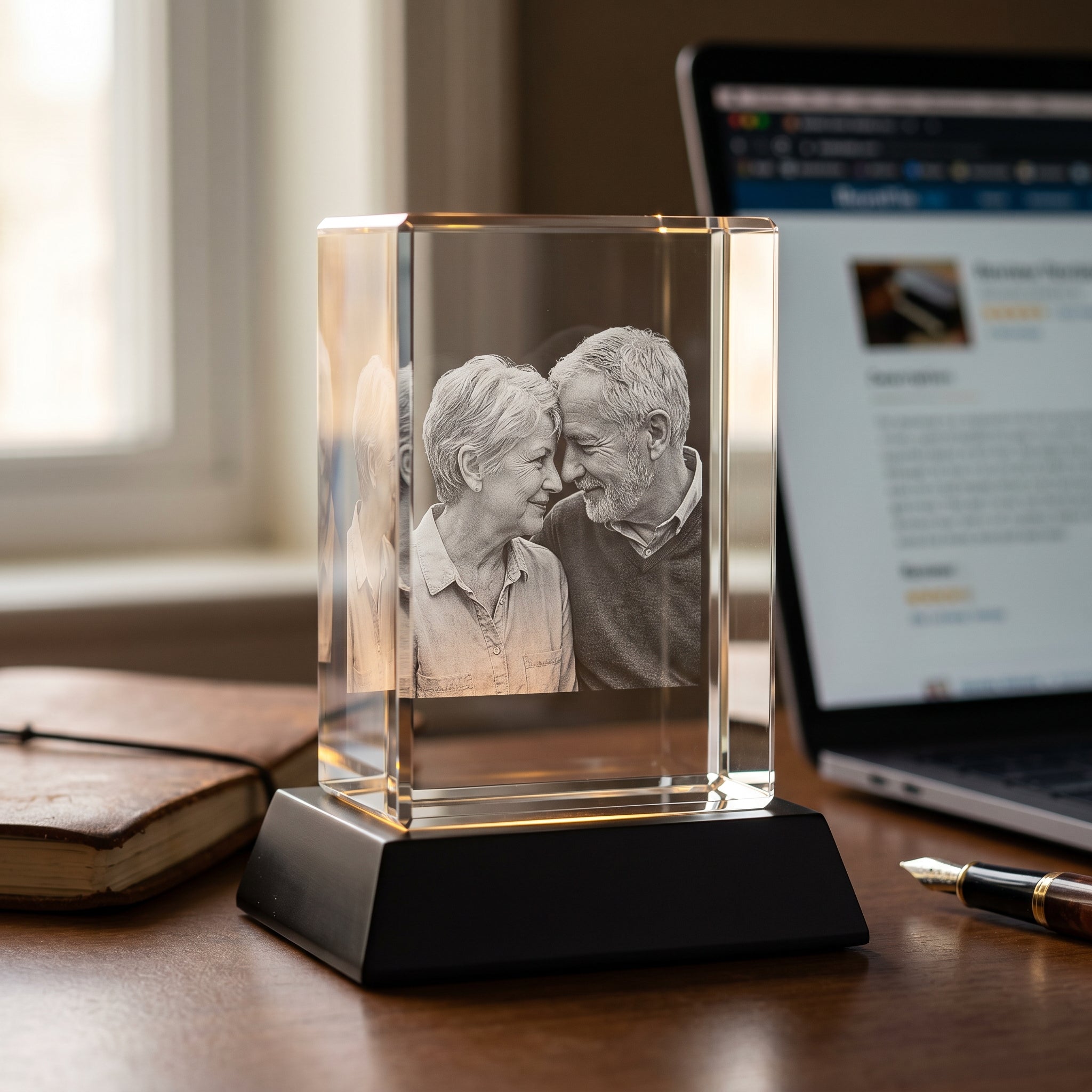
The most technically advanced of the three, and the one Beyond Memories specializes in. A focused laser beam pulses millions of microscopic fracture points inside the volume of a solid block of K9 optical crystal — not on the front face, not on the back face, but throughout the interior of the crystal. Each point is a tiny bright defect; aggregated, the points form a continuous-tone grayscale photograph that appears to float in three dimensions inside the glass. We walk through the technical process in our piece on how 3D photo crystals work.
What it looks like
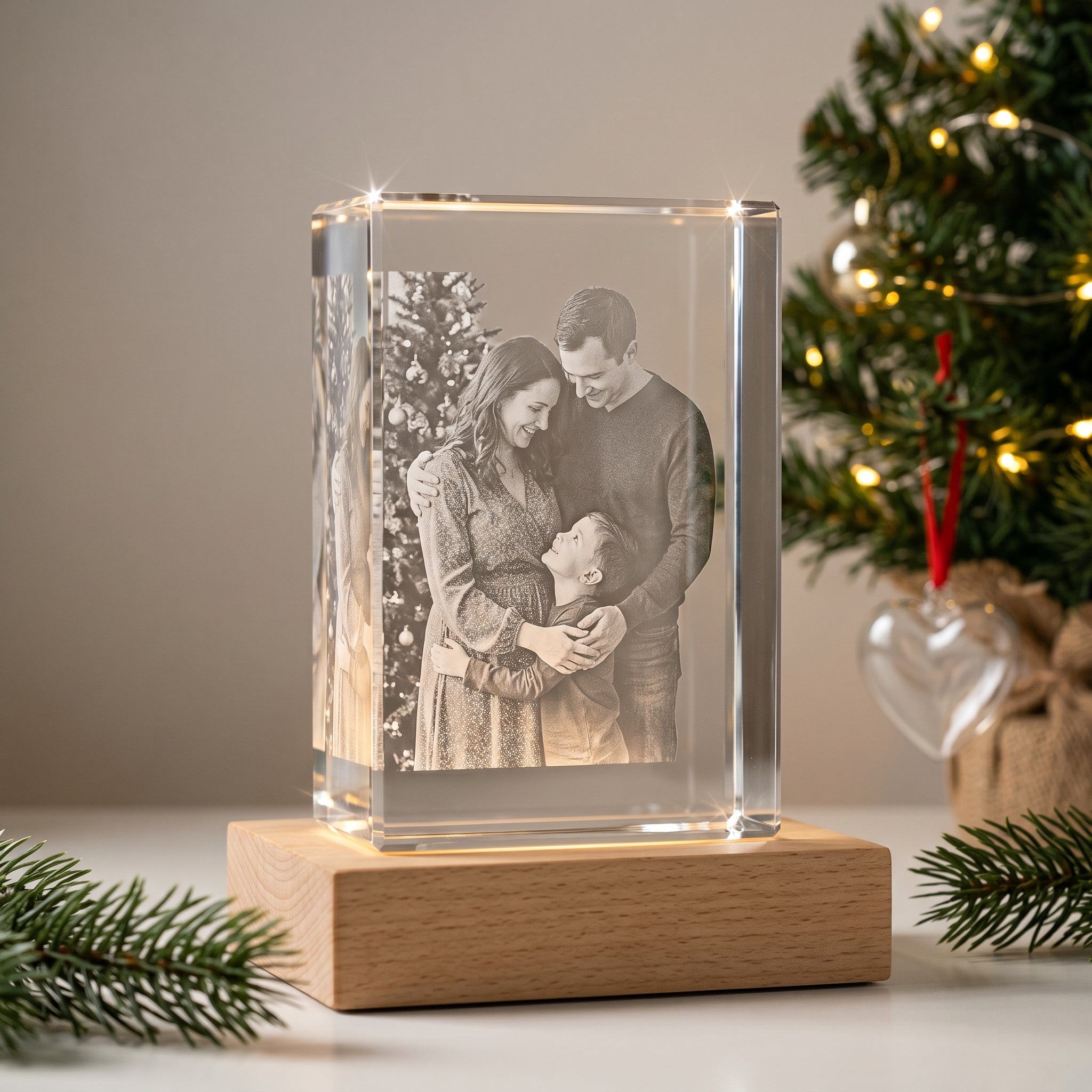
A photographic-quality grayscale portrait suspended inside a solid crystal block. Faces are clearly recognizable — eyes, expressions, hair texture, clothing detail, all rendered in fine grayscale tones. The image has true depth: walk around the crystal and the portrait shifts perspective subtly, like looking at a hologram. Lit from below by a Memory Light Base™, the engraving glows softly amber-warm at the base joint and lifts the image into clear visibility from across a dark room.
Pros
- Continuous tone. The full grayscale gradient renders — close-up faces look like actual photographs, not stencils.
- True 3D depth. The image occupies the full interior volume; perspective shifts as you move around the crystal.
- Permanent. The etched points are inside the glass, sealed by the surrounding crystal volume on all sides. Nothing to scratch off, nothing to fade. The image you receive is the image at year fifty.
- Substantial weight and presence. A 3D crystal is a solid block (1.5 to 6 inches tall) — it reads as a sculpture, not a print.
- Lighting compatibility. Designed to work with an LED light base; lit from below, the engraved photo lifts into glowing visibility (see our piece on whether you need a light base).
Cons
- Grayscale only. Like surface etching, the engraving is monochromatic. Color photos lose their color (though grayscale conversion of a portrait often reads more timeless than the color original).
- Higher price point. A 3D Memory Crystal™ runs $79–299 depending on size, reflecting the time-intensive 3D modeling and engraving process. See our breakdown of 3D crystal versus canvas pricing for context.
- Requires a good source photo. The engraving is faithful to the input — a blurry low-resolution photo will produce a blurry engraving. Our guide on how to choose a photo for a 3D crystal walks through what works and what doesn't.
Best for
Highest-stakes memory keepsakes — wedding portraits, milestone anniversaries, memorial portraits, baby and family portraits, pet memorials. Anything where the photo is the most important photo, not just one of many. For format-versus-format trade-offs, see our piece on 3D crystal versus metal print.
Side-by-side comparison
| Attribute | UV-printed glass | Surface-etched glass | 3D subsurface crystal |
|---|---|---|---|
| Color rendering | Full color | White on clear (mono) | Grayscale photographic |
| Depth perception | Flat (back surface) | Flat (front surface) | True 3D inside volume |
| Photo realism | Photo-like | Stencil-like | Photographic |
| Fade resistance | 5–10 yrs in sun | Permanent | Permanent |
| Scratch resistance | Ink can lift | Surface dust accumulates | Internal, sealed |
| Lighting compatibility | Ambient only | Ambient or back-lit | LED base from below |
| Typical price (small) | $20–40 | $30–80 | $79–299 |
| Best photo type | Color, vibrant | High contrast | Close-cropped portrait |

When to choose which
Pick UV-printed glass if
The photo is full of color you don't want to lose (a sunset, a wedding bouquet, kids in bright clothes), the budget is under $50, and the gift is meant for a 5–10 year horizon — a kitchen shelf, a guest bedroom, a casual gift exchange. Don't choose UV-print for a photo you want to last forever.
Pick surface-etched glass if
The image is high-contrast and silhouette-friendly (a profile, a couple in pose, a single bold subject), or if the engraving is text-heavy (a wedding inscription, a memorial dedication). Best for decorative panels and custom plaques where a frosted aesthetic is the look you want.
Pick a 3D subsurface crystal if
The photo is the most important photo — a wedding portrait, a final photo of a parent, a milestone family portrait, a beloved pet. The recipient is going to keep this for the rest of their life and beyond, so the format needs to last that long too. The image is a close-cropped portrait (face or faces visible, close-in framing). Browse the 3D crystal photo collection to see the available shapes, or jump to the rectangle 3D Memory Crystal™ as the most popular starting point.
Why Trust Beyond Memories
Beyond Memories has been featured in USA Today's 2025 Gift Guide and crafts more than 150,000 personalized 3D Memory Crystal™ keepsakes for families across America. Every crystal is hand-inspected at our US facility before shipping, with a 4.9 ★ rating from 20,500+ verified reviews.
Frequently Asked Questions
Are glass pictures the same as crystal pictures?
Technically, all crystal is glass, but "crystal pictures" usually refers to the higher-grade K9 optical crystal used for subsurface 3D engraving, while "glass pictures" usually refers to flat glass panels printed or etched on the surface. The substrate matters: optical crystal is clearer, more refractive, and better suited to laser engraving than standard soda-lime glass.
Will a glass picture fade in sunlight?
UV-printed glass photos will fade noticeably in 5–10 years of direct sun exposure, with cyan and magenta inks degrading first. Surface-etched and subsurface 3D crystal photos do not fade — the engraving is physical, not chemical, and the underlying optical glass is UV-stable.
Can a 3D crystal photo be in color?
No — the subsurface laser engraving process produces grayscale only, because each etched point is the same size and intensity. The image is rendered as continuous-tone grayscale, similar to a black-and-white photograph. Many people find that grayscale renders portrait subjects more timelessly than color.
How long do glass pictures last?
UV-printed: 10–20 years before noticeable color shift, longer if kept out of direct sun. Surface-etched: indefinitely — the etching is permanent, though surface dust and oils may need occasional cleaning. Subsurface 3D crystal: indefinitely — the engraving is sealed inside the crystal volume, with no exposure to air, light degradation, or surface wear.
What's the best photo format for a wedding gift?
For a wedding gift meant to last decades, a subsurface 3D crystal of the couple's portrait is the highest-fidelity option. UV-printed glass works for casual color photos. Surface-etched glass works for inscription-heavy memorial plaques. The choice depends on whether the gift is a casual decoration or a generational keepsake.
Looking for related comparisons? See our guides on 3D crystal vs canvas and 3D crystal vs metal print.