
K9 Optical Crystal vs. Other Glass: Why Material Matters for Photo Engraving
By Beyond Memories Editorial Team · May 18, 2026 · 8 min read
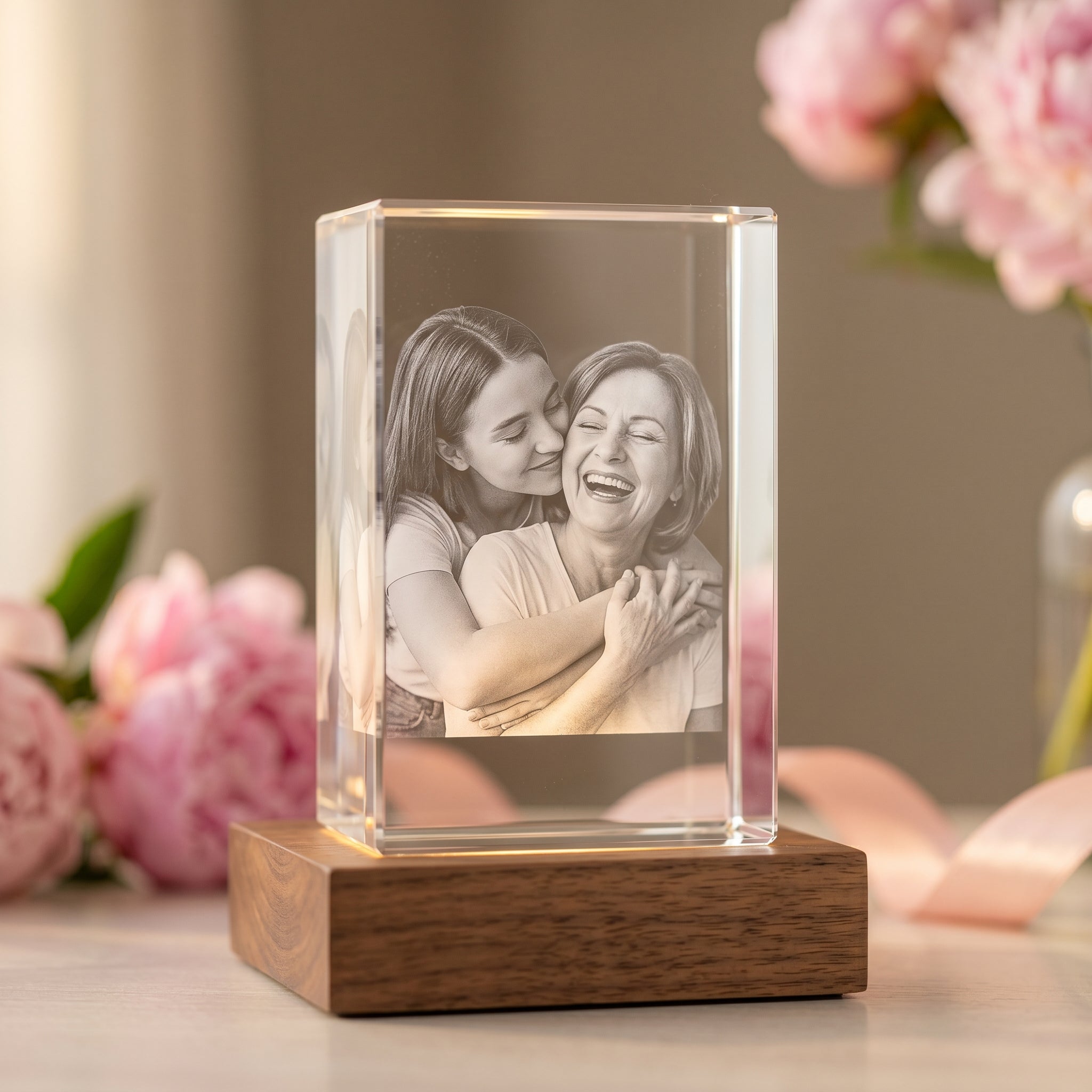
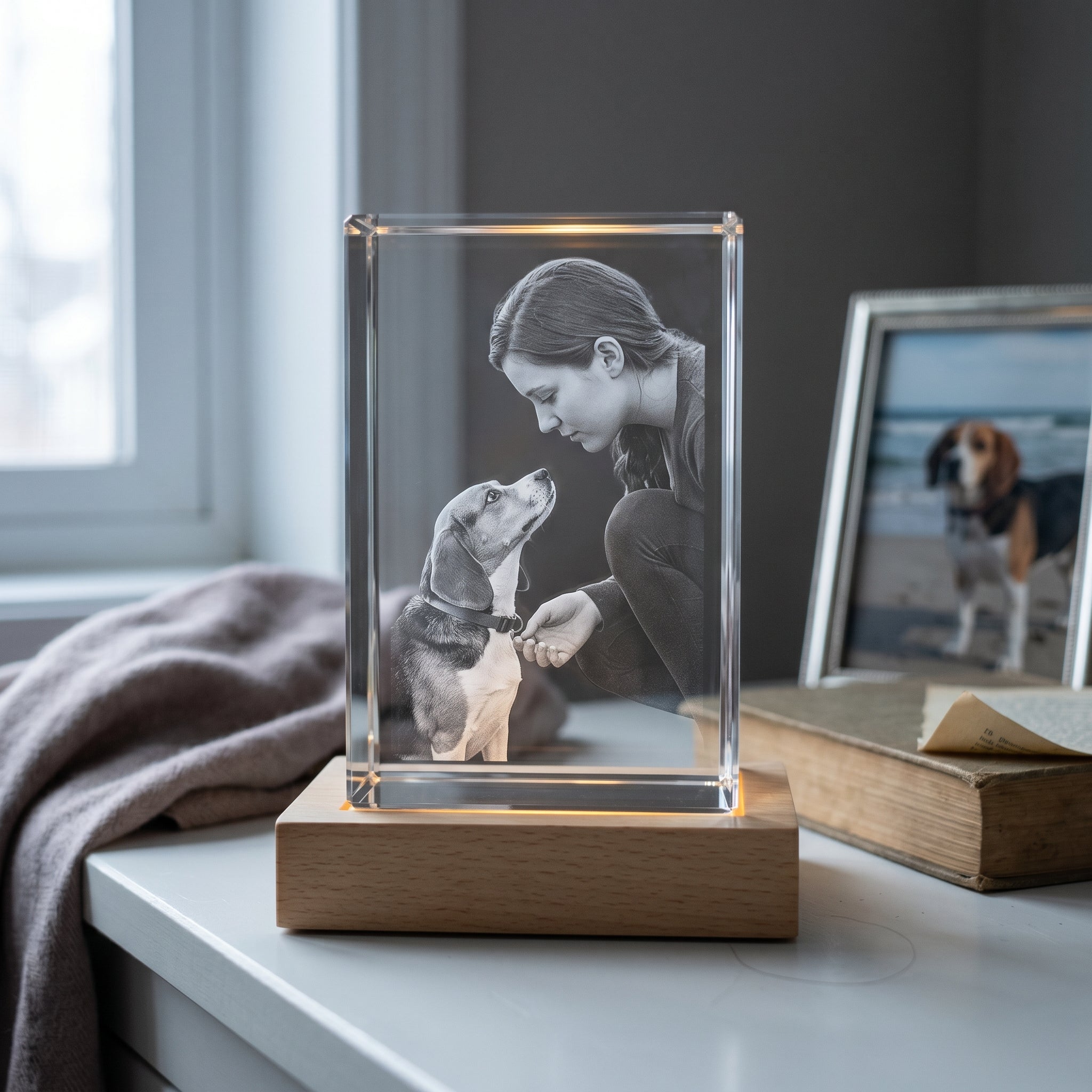
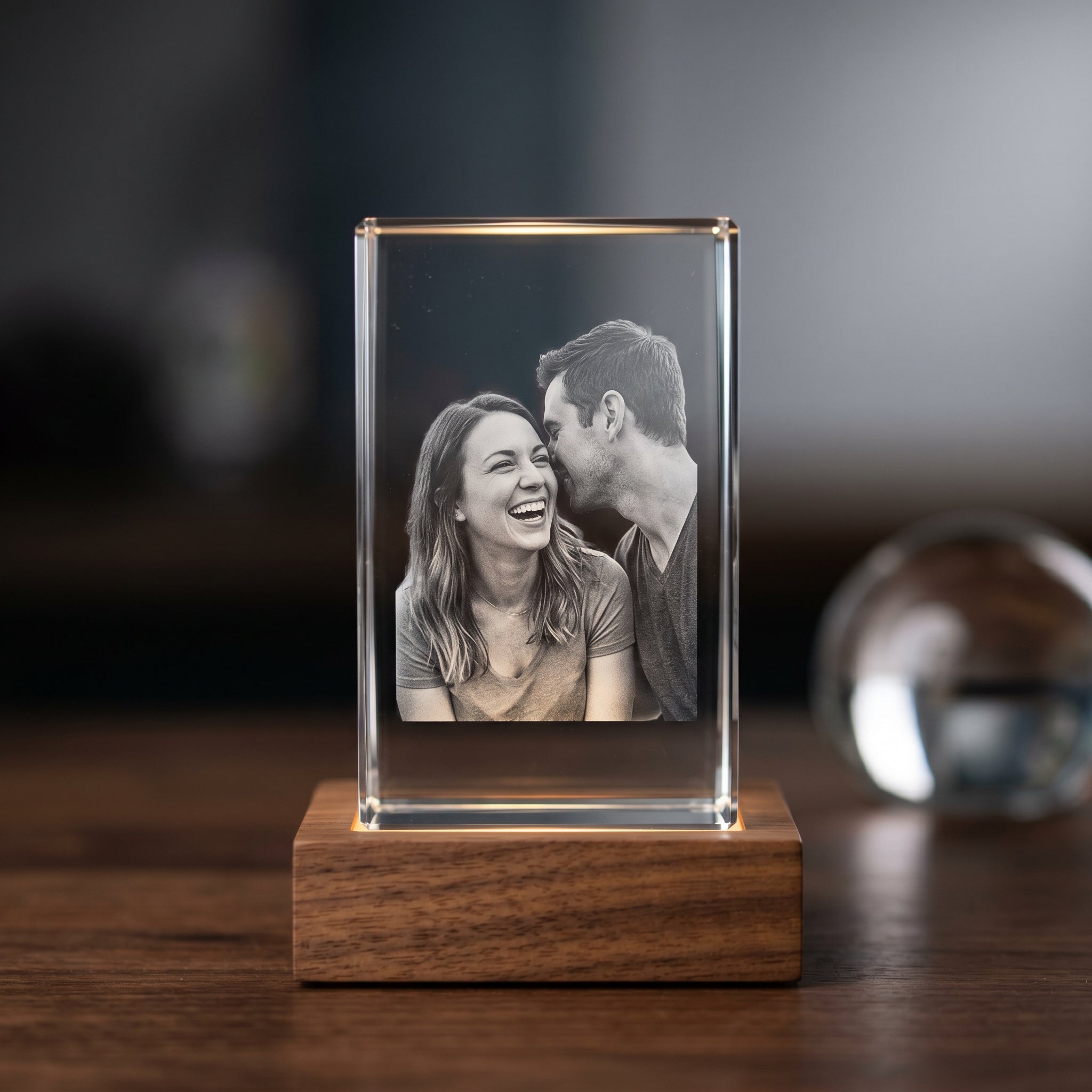
K9 optical crystal is a high-purity borosilicate crown glass with above-90% light transmission, used in fine optics, precision lenses, and Beyond Memories® 3D Memory Crystal™ keepsakes. It outperforms standard soda-lime glass, etched glass, acid-etched glass, and acrylic on the four properties that matter for photo engraving: clarity, light transmission, scratch resistance, and longevity under daily display.
This guide compares K9 optical crystal against the materials it competes with for photo gifts and engraved keepsakes. Each material has legitimate uses, and we are honest about where K9 is overkill and where it is the only sensible choice. By the end you will know exactly why a Beyond Memories crystal feels different in the hand than an etched glass photo from a craft store, and what that difference will look like in twenty years.
Table of Contents
- What K9 optical crystal actually is
- Standard soda-lime glass (window glass, drinking glass)
- Etched glass and acid-etched glass
- Borosilicate (Pyrex-class lab glass)
- Acrylic (the "crystal-look" plastic)
- A note on crystal cut and lead crystal
- Side-by-side comparison
- Why Beyond Memories uses K9 specifically
- Frequently Asked Questions
What K9 optical crystal actually is
K9, sometimes labeled H-K9L or treated as the BK7 equivalent in optical catalogs, is a borosilicate crown glass formulated for high-precision optical work. Telescope objective lenses, camera prisms, laser focusing optics, and scientific instruments all use the same family of glass. The composition includes silica, sodium oxide, potassium oxide, boron oxide, and barium oxide in tightly controlled proportions. The "K" comes from the German Kron ("crown"), an old optical-glass classification denoting low dispersion and high visible-light transmission.
The properties that matter for photo engraving:
- Refractive index ~1.516, light passes through with minimal distortion, which keeps the engraved photograph reading sharply from any angle
- Light transmission above 90% across the visible spectrum, no green or yellow cast even when viewed edge-on
- Internal homogeneity, virtually no bubbles, striae, or inclusions that would deflect a focused laser pulse
- Hardness ~6 on the Mohs scale, resistant to surface scratching from ordinary handling
- Annealed slowly during manufacture to eliminate internal stress, which prevents micro-cracking under temperature changes
Those properties are what allow subsurface laser engraving to produce a clean, consistent photographic image inside the volume of the crystal. The same engraving in a lower-grade glass would show visible inconsistencies in dot density, light scatter, and color cast.
Standard soda-lime glass, what most "glass" actually is
Roughly 90% of the world's glass production is soda-lime: the material in window panes, beer bottles, drinking glasses, picture frames, and most low-cost "glass photo blocks" sold in craft stores and on marketplace sites. It is cheap, mass-produced, and adequate for many uses.
It is not adequate for photo engraving in the same way K9 is. Soda-lime glass typically contains a faint green tint from iron impurities, visible when you look at a window pane edge-on. Its internal homogeneity is much lower than optical crystal, with more bubbles, more striae, and more refractive variation across the volume. Its light transmission sits closer to 85% across the visible range, with disproportionate absorption at the red end of the spectrum.
For surface-printed photo blocks, this is fine, the photo is on the surface, and the glass is just a substrate. For subsurface-engraved photo crystals, soda-lime produces a visibly worse result: the engraved image looks slightly cloudy, takes on a faint green cast, and the dot density varies across the volume. It is one of the reasons there is a real price gap between a craft-store glass photo block and a true 3D Memory Crystal™. They are not made of the same material.
Best use for soda-lime: functional glassware, windows, jars, and budget photo frames where optical purity does not matter.
Etched glass and acid-etched glass, beautiful for surface art, wrong for photographs
Etched glass is a broad category covering any glass with a frosted decorative pattern produced by removing material from the surface. The two dominant techniques:
Acid-etched glass
Acid etching uses hydrofluoric acid (or a safer fluoride-salt cream) to chemically dissolve the surface of the glass in a controlled pattern, leaving a soft frosted finish. The technique is centuries old and produces beautifully even, low-glare surfaces, which is why architects use acid-etched glass in shower doors, partition walls, and decorative panels. It gives a gentle, diffused look that no other glass treatment matches.
Mechanical and laser surface etching
Sandblasting and surface laser ablation produce similar frosted finishes by physically removing material rather than chemically dissolving it. These are the techniques behind most engraved awards plaques, trophies, and surface-engraved keepsakes.
Why etched glass is wrong for a photograph
Both acid etching and surface laser etching create images on a flat plane on the outer face of the glass. They cannot reproduce three-dimensional volume. They collect dust and fingerprints in the frosted depressions. They look great with bold text, geometric patterns, and simple line art, and frankly underwhelming with photographic detail, because the technique cannot resolve continuous-tone grayscale at fine pixel densities. Detail in skin, hair, and clothing texture gets lost in the frosting.
Etched glass also has the same long-term wear pattern as any frosted surface: years of handling, dusting, and occasional contact accumulate as visible scuffs in the frosting. It is a different category of object from a sealed-volume subsurface engraving. We compare the two formats more directly in our glass pictures vs. 3D crystal guide.
Best use for etched glass: architectural panels, trophy text engraving, decorative line-art designs, awards.
Borosilicate (Pyrex-class lab glass), durable, decent clarity, but suboptimal for engraving
Borosilicate glass is the broader family that K9 belongs to, but lab-grade borosilicate (the kind used for Pyrex measuring cups and chemistry beakers) is formulated for thermal-shock resistance rather than optical clarity. It transmits light well, comparable to soda-lime, but is harder to subsurface-engrave cleanly because its specific composition does not respond as predictably to a focused green laser.
Its real strength is heat tolerance: borosilicate handles rapid temperature changes that would crack soda-lime or K9. That makes it the right material for cookware, lab equipment, and lighting fixtures. It is the wrong material for a photo keepsake meant to be handled, displayed, and held.
Best use for borosilicate: lab glass, cookware, high-temperature lighting, anywhere thermal stress matters more than optical perfection.
Acrylic, the "crystal-look" plastic that is not crystal at all
Acrylic, sold under brand names like Plexiglas, Lucite, and Perspex, is a transparent thermoplastic. It looks similar to glass at first glance, weighs about half as much, and is roughly seventeen times more impact-resistant than soda-lime glass. Those are real advantages for some applications.
For a photo keepsake, acrylic underperforms on every relevant axis except weight:
- Scratch resistance: acrylic is much softer than glass (Mohs ~3 vs. ~6 for K9). Surface scratches accumulate from normal handling, dusting, and even soft-cloth wiping over time. Within a few years, an acrylic photo block typically shows visible micro-scratches across the front face that diffuse and dim the image.
- UV stability: acrylic yellows under sustained UV exposure. A piece displayed near a sunny window will develop a faint yellow tint within five to ten years.
- Engraving: acrylic cannot be subsurface-engraved by the same green-laser process used for K9. So-called "acrylic photo blocks" are surface-printed (a photo printed onto the back face) or sandwich-laminated (a paper or film insert sealed inside two acrylic plates). Neither is engraving. The image lives on a printed substrate that can fade, peel from the substrate over years, or shift under temperature changes.
- Edge clarity: acrylic edges scatter light less crisply than polished glass bevels, which gives the piece a softer, less premium feel in the hand.
- Heat sensitivity: acrylic deforms above about 160°F (71°C). A car dashboard in summer can soften it.
Acrylic is a legitimate choice when you need shatter-resistance (kids' frames, outdoor displays, shipping concerns) or low weight. It is not a legitimate choice when you want a photographic keepsake to look the same in a decade as it does today. We cover this comparison in detail in our acrylic photo block vs. crystal breakdown.
Best use for acrylic: children's photo frames, outdoor or marine displays, anywhere weight or shatter-resistance is the deciding factor.
A quick note on "crystal cut" and lead crystal
The phrase crystal cut in retail glassware usually refers to the technique of cutting decorative facets into the surface of leaded crystal, the kind of pattern you see in Waterford bowls and traditional whisky glasses. Lead crystal contains lead oxide (24% or higher) which raises its refractive index to about 1.55, gives it the heavy "ringing" quality when tapped, and produces the rainbow-like sparkle along faceted cuts.
Lead crystal is a beautiful decorative material, but it is not optimal for subsurface laser engraving. The lead content makes the glass softer and more prone to deforming under the laser focus, the breakdown threshold is less consistent across the volume, and the resulting engraving lacks the clean dot-by-dot precision of K9. Lead crystal is the right material for cut-glass decanters and decorative bowls. It is the wrong material for a photographic engraving inside the volume of the glass.
The faceted bevel edges of a Beyond Memories 3D Memory Crystal™ provide the same kind of light-catching specular highlights as cut crystal, but the body of the crystal stays optically clear and pure, the right balance for an engraved photograph that needs to read clearly through the glass.
Side-by-side comparison
The practical differences across the materials that compete in this category:
Clarity (visible light transmission)
- K9 optical crystal: above 90%, no color cast
- Borosilicate (lab grade): about 90%, very slight cast
- Soda-lime glass: about 85%, faint green cast edge-on
- Lead crystal: about 88%, slight warm cast from lead oxide
- Acrylic: 92% when new, drops over years of UV exposure
Hardness and scratch resistance
- K9 optical crystal: Mohs 6, resistant to ordinary handling
- Borosilicate: Mohs 6, resistant
- Soda-lime: Mohs 5.5, moderate
- Lead crystal: Mohs 5, softer than K9
- Acrylic: Mohs 3, scratches from soft cloth wiping over time
Fade resistance (image stability over decades)
- K9 + subsurface engraving: indefinite, no pigment, only structural fractures
- Etched glass: indefinite for the etching itself, but surface accumulates wear
- Soda-lime + surface print: dependent on ink and seal, typically 10-30 years
- Acrylic + insert print: insert can fade within 5-15 years
- Lead crystal: indefinite for cut features, not used for photo engraving
Weight (perceived quality in the hand)
- K9 optical crystal: heavy, cool to the touch, substantial
- Lead crystal: heaviest of all, very dense
- Borosilicate: medium weight
- Soda-lime: medium weight
- Acrylic: light, often feels less premium than expected
Cost (per comparable size, retail)
- K9 optical crystal photo: premium (the optical-grade material plus the engraving process)
- Lead crystal decorative: premium for cut-glass, no photo engraving
- Borosilicate functional: low to mid
- Soda-lime printed photo block: low
- Acrylic photo block: low
Why Beyond Memories uses K9 optical crystal specifically
The decision to use K9 is not branding. It is the practical sweet spot across the four properties that matter for a subsurface-engraved photo keepsake: optical clarity high enough that the engraving reads cleanly from any angle, hardness high enough that the piece survives decades of display without surface scratching, predictable behavior under the laser so that every dot in the engraved photograph lands at full density, and a polished bevel quality that catches ambient light along the edges and gives the crystal its characteristic glint.
None of the alternatives match all four. Soda-lime is too impure for the engraving to read cleanly. Lead crystal is too soft and inconsistent under the laser. Borosilicate is durable but engrades less predictably. Acrylic is the wrong substrate entirely, it cannot be subsurface-engraved and it scratches and yellows over years.
The result is a finished crystal that does what the marketing promises: an engraved photograph suspended inside a clear optical block, looking the same in twenty years as it does on the day it ships. You can see the full range of shapes, heart, rectangle, cube, hexagon, arc, in our 3D crystal photo collection. For broader format comparisons against canvas, metal print, and other photo gifts, see our guides on 3D crystal vs. canvas and 3D crystal vs. metal print, plus our overview of crystal art personalized photos.
Why Trust Beyond Memories
Beyond Memories has been featured in USA Today's 2025 Gift Guide and crafts more than 150,000 personalized 3D Memory Crystal™ keepsakes for families across America. Every crystal is hand-inspected at our US facility before shipping, with a 4.9 star rating from 20,500+ verified reviews.
Frequently Asked Questions
What is K9 optical crystal made of?
K9 optical crystal is a borosilicate crown glass containing silica, sodium oxide, potassium oxide, boron oxide, and barium oxide in tightly controlled proportions. The same family of glass is used in telescope lenses, camera prisms, and scientific optics.
Is K9 the same as regular crystal?
No. "Crystal" in everyday language often refers to lead crystal (used in cut-glass decanters and chandeliers) or simply to clear glass. K9 is a specific optical grade with above-90% light transmission, almost no internal impurities, and a refractive index suited to precision lens work. It is significantly purer than ordinary lead crystal or soda-lime glass.
How is etched glass different from a 3D Memory Crystal?
Etched glass, including acid-etched glass, has a frosted decorative pattern on the outer surface of the glass. A 3D Memory Crystal has a photographic image engraved inside the volume of the glass via subsurface laser engraving. The etched-glass image lives on a flat surface plane and reads as a translucent decoration; the 3D crystal image lives in three-dimensional volume and reads as a luminous photograph suspended inside clear glass.
Will an acrylic photo block last as long as a crystal one?
No. Acrylic scratches easily under normal handling and yellows under sustained UV exposure. Most acrylic photo blocks are also surface-printed or insert-laminated rather than engraved, so the image itself can fade within 5 to 15 years. A subsurface-engraved K9 crystal has no pigment to fade and a hard glass surface that resists scratching, so the image stays the same indefinitely.
Why does light transmission matter for a photo crystal?
The engraved photograph is read by the eye through the body of the crystal. Higher light transmission means the image reads brighter and sharper from every angle, with no color cast distorting the grayscale tones. Lower-clarity glass dims and discolors the image, most visibly toward the edges of the crystal where the light path through the glass is longest.
Does K9 crystal contain lead?
No. K9 is a borosilicate crown glass with no lead content. Lead crystal is a different material formulated for decorative cut-glass work. K9 is formulated for optical clarity and laser-engraving consistency.
Looking for related guides? See our subsurface laser engraving explainer and our comparison of glass pictures vs. 3D crystal.