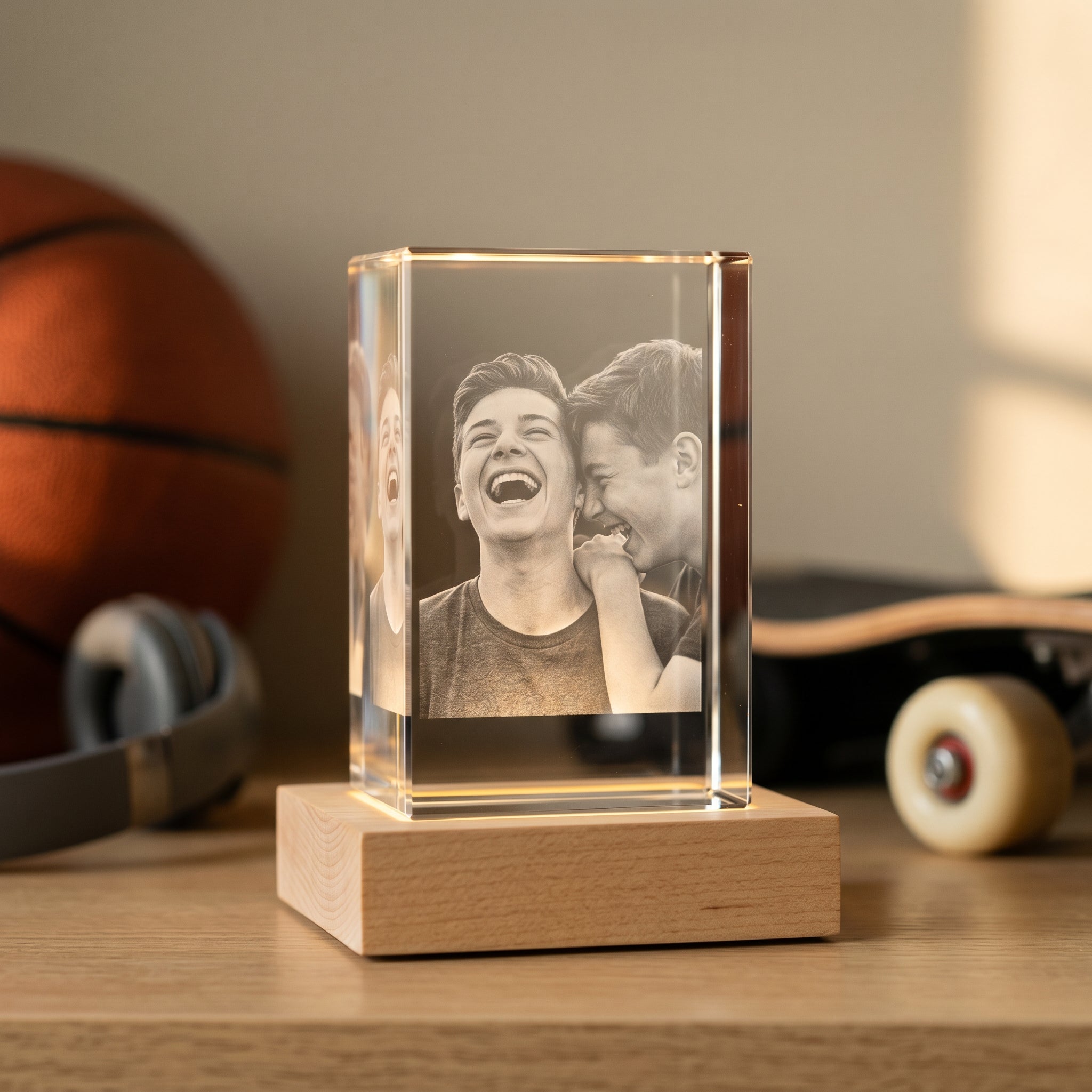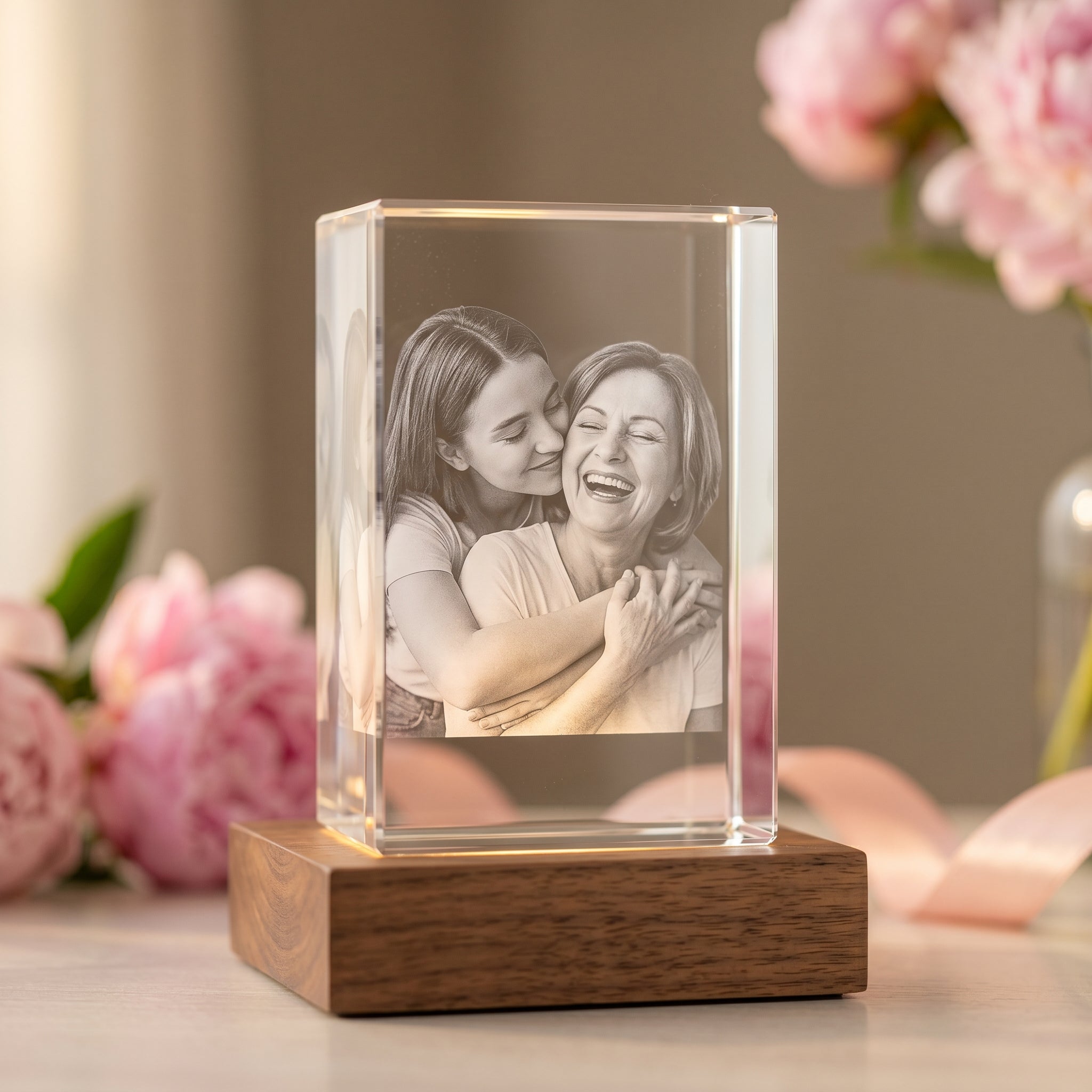

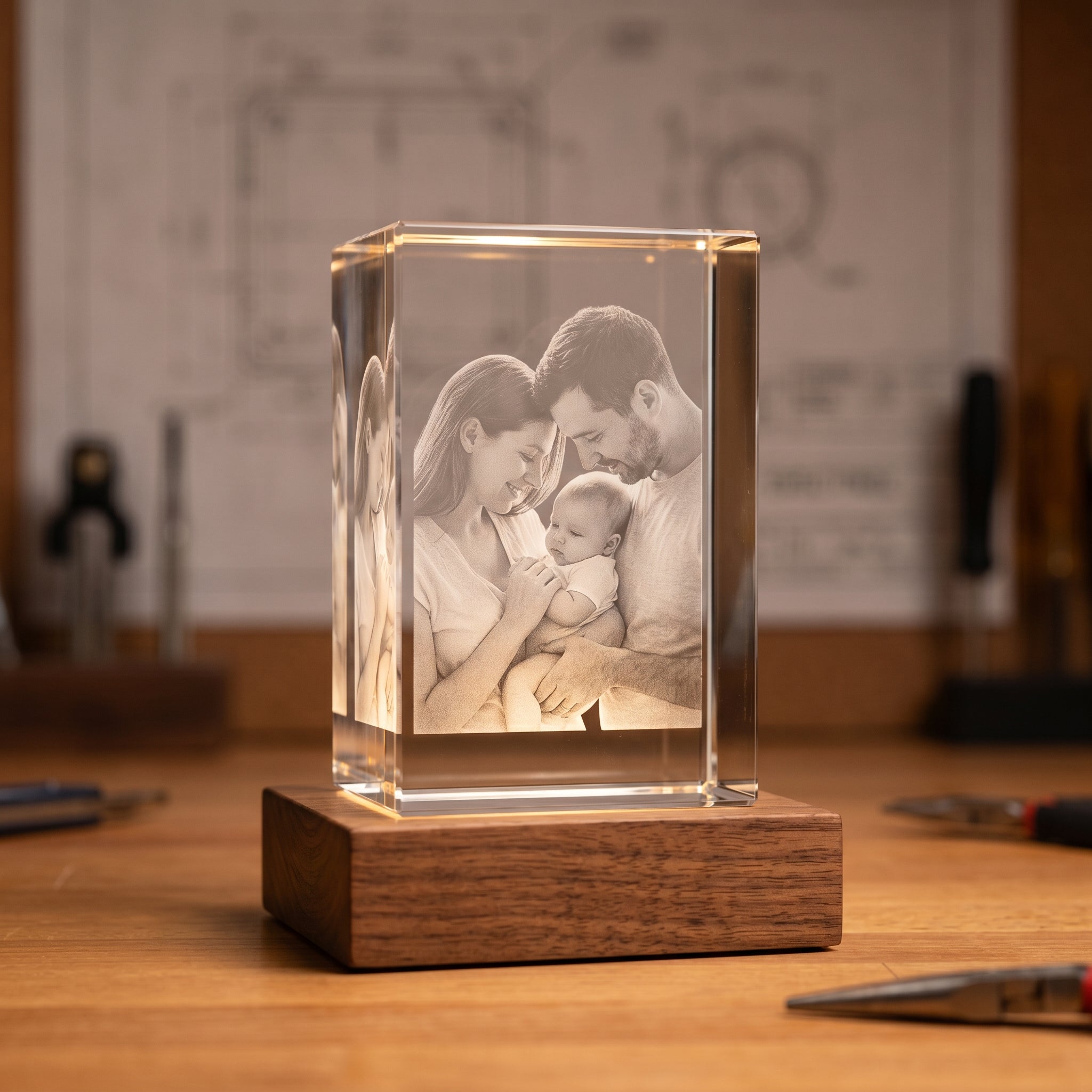
Subsurface Laser Engraving Explained: How a 3D Photo Crystal Is Made
By Beyond Memories Editorial Team · May 18, 2026 · 9 min read
Subsurface laser engraving is the process of using a tightly focused, high-intensity laser to create millions of microscopic fractures inside a solid block of optical crystal, leaving the outer surface completely untouched. The result is a photograph that lives inside the glass volume rather than printed on it, which is why it does not fade, peel, scratch, or wear off.
This guide walks through exactly how a 3D Memory Crystal™ is produced, from the optical-grade K9 crystal blank to the finished, hand-inspected keepsake. Read it once and you will understand the physics, the material choices, and the production realities that separate a real subsurface-engraved crystal from a printed glass photo or a surface-etched novelty.
Table of Contents
- What subsurface laser engraving actually is
- Subsurface vs. surface engraving
- Why K9 optical crystal, and what it is not
- The full production process, step by step
- What makes a good photo for the process
- Common myths debunked
- Why this matters for your photo
- Frequently Asked Questions
What subsurface laser engraving actually is
Subsurface laser engraving, sometimes shortened to SSLE, sometimes called sub-surface laser etching, is a manufacturing process developed in the late 1990s for marking transparent materials from the inside out. The principle is straightforward, even if the engineering behind it is not.
A pulsed laser beam, typically operating in the green-light range around 532 nanometers, is focused through a precision lens system to a single point inside a transparent crystal block. At that focal point, the energy density becomes high enough to exceed the breakdown threshold of the glass, but only at that exact point. Everywhere else along the beam path, including the surface the beam enters through, the energy is too diffuse to do any damage.
When the beam reaches that focal point, it creates a microscopic fracture, a single bright defect about the diameter of a human hair, suspended inside otherwise perfect glass. By moving the focal point through the volume of the crystal in three dimensions and pulsing the laser hundreds of thousands of times per second, the machine paints a cloud of these tiny fractures into a recognizable shape: a face, a pet, a family group, a logo.
The physics in plain language
Think of it this way. A magnifying glass on a sunny day burns paper because it concentrates sunlight into a single point. The light passing through the lens does not burn the air it travels through, it only burns at the focal point. Subsurface laser engraving works on the same principle, just at industrial scale: the laser pulses are intense enough to damage glass, but only at the focused point. The rest of the beam path, including the polished outer surface, is left untouched.
Each microscopic fracture scatters light when ambient illumination hits it, which is what makes the engraved areas appear bright and luminous against the otherwise transparent crystal. The unengraved volume stays optically clear. That contrast, bright dots against clear glass, is what produces the floating, three-dimensional photograph effect that defines a real 3D photo crystal.
Subsurface vs. surface engraving, why the difference matters
Most engraved glass on the market is surface-etched, not subsurface-engraved. The two processes look superficially similar in marketing photos, but they age very differently.
Surface engraving (what most "engraved glass" actually is)
Surface engraving, whether produced by sandblasting, acid etching, rotary bits, or even surface-level laser ablation, physically removes material from the outside face of the glass. The result is a frosted or scratched surface that catches light from the front. It is the technique behind laser engraving plaques and most crystal vases with engraving.
Surface engraving has real strengths: it is fast, cheap, well-suited to text and simple line art, and it is the only sensible option for opaque materials. But it has clear weaknesses for photographic work. The frosted surface is a physical depression in the glass, it collects fingerprints and dust, scratches accumulate over years of handling, and the engraving sits on a flat plane rather than occupying volume. It cannot produce a three-dimensional image.
Subsurface engraving (the Beyond Memories process)
Subsurface engraving never touches the surface. The outer faces of the crystal stay polished and bevel-sharp; the photograph lives inside the volume of the glass, suspended in three dimensions. Because the engraved points are sealed behind solid glass, they cannot be scratched, smudged, faded, or worn off by handling. The image is locked into the crystal as permanently as the crystal itself.
That is the practical difference. A surface-etched photo block ages like a printed photograph behind a frame, over years, the surface gathers wear. A subsurface-engraved 3D Memory Crystal™ ages like a piece of solid glass, because that is exactly what it is.
Why K9 optical crystal, and what it is not
The blank that goes into the laser machine is not generic "crystal." It is K9 optical crystal, a specific grade of borosilicate glass formulated for high-precision optical use. Telescope lenses, camera prisms, laser optics, and scientific instruments use the same material. We use it for the same reason: clarity, internal purity, and a refractive index that lets light pass through without distortion.
What "K9" actually means
K9 (sometimes written H-K9L or BK7-equivalent) is a borosilicate crown glass with a refractive index of about 1.516. The "K" comes from the German word Kron, meaning crown, a centuries-old optical-glass classification denoting low dispersion and high transmission across the visible spectrum. It contains silica, sodium oxide, potassium oxide, boron oxide, and barium oxide in tightly controlled proportions, melted, refined, annealed slowly to prevent internal stress, and finally optically polished.
The relevant properties for subsurface engraving:
- Light transmission above 90% across the visible range, clear glass with no green or yellow cast
- Internal homogeneity with virtually no bubbles, striae, or inclusions that could deflect the laser focus
- Predictable breakdown threshold, the laser power needed to produce a clean microscopic fracture is consistent across the volume, which means consistent point density across the engraved photograph
- Hardness around 6 on the Mohs scale, durable enough to handle daily use without surface scratching from typical contact
Inferior alternatives we do not use
Several materials get marketed as "crystal" but produce visibly worse results:
Standard soda-lime glass, the same material as drinking glasses and window panes. Cheaper, but contains more bubbles and impurities, has lower light transmission, and often carries a faint green tint when viewed edge-on. Subsurface engraving in soda-lime produces visible inconsistencies in the dot density across the image.
Acrylic ("crystal-look" plastic), lightweight, shatter-resistant, but not crystal in any technical sense. Acrylic scratches easily, yellows under UV exposure over years, and cannot be subsurface-engraved by the same process. So-called "acrylic photo blocks" are usually surface-printed, not engraved at all. We compare these directly in our glass pictures vs. 3D crystal guide.
Fluorite ("optical fluorspar"), has even better optical properties than K9 in some narrow-band applications, but is significantly softer (Mohs 4), more brittle, and prone to cleaving along crystal planes. It is the wrong material for a keepsake meant to be handled, displayed, and lived with for decades.
Quartz (synthetic or natural), extremely hard and clear, but harder to engrave subsurface cleanly because of its directional crystal structure. Used for some industrial applications, but not optimal for photographic reproduction.
K9 is the practical sweet spot: optical-grade clarity, durable hardness, predictable behavior under the laser, and stable across a normal lifetime of display.
The full production process, step by step
From upload to shipped keepsake, a Beyond Memories 3D Memory Crystal™ passes through six distinct production stages. Standard production is 5 to 7 business days; express production runs 1 to 2 business days.
1. Photo intake and review
The customer-uploaded photograph is reviewed manually by a human artist on our team. We check resolution, lighting, contrast, focal length, and the suitability of the crop for three-dimensional engraving. Photos that will not produce a clean engraving, too low resolution, too dark, too shadowed, too cluttered, get flagged at this stage so the customer can replace the file before any glass is touched. Our guide on how to choose a photo for a 3D crystal walks through what makes a good source.
2. 3D model conversion
The 2D photograph is processed through proprietary software that converts it into a three-dimensional point cloud, a volumetric grid of coordinates where each point represents one future microscopic fracture. The software accounts for the geometry of the chosen crystal shape (heart, rectangle, cube, hexagon, arc), the size of the blank, and the optical depth of the engraving relative to the viewing angle. Skin tones, hair texture, clothing detail, and background separation all get translated into varying point-density maps.
3. Laser machining
The K9 blank is loaded into a precision laser machining station. A green pulsed laser, focused through a high-NA lens assembly, fires a programmed sequence of pulses through the crystal volume. The focal point moves through the glass on a three-axis stage, depositing each microscopic fracture at its assigned coordinate. A typical portrait engraving involves between 500,000 and 2 million individual laser pulses, depending on crystal size and image complexity. Total laser time per piece runs roughly 15 to 90 minutes.
4. Polishing and finishing
Although the laser leaves the surface untouched, every crystal is hand-polished after engraving to remove any handling marks, dust, or fingerprints from the production process. Bevel edges are sharpened to a clean specular finish, those are the bright glints you see catching room light along the edges of the finished crystal. Our process for laser etching in crystal covers this finishing step in more detail.
5. Inspection
Every crystal is hand-inspected by an artist before it leaves our US facility. The engraved photograph is checked for clarity, dot consistency, and faithful reproduction of the source photo. The crystal body is checked for surface flaws, bevel quality, and any internal defects. Pieces that do not meet our standard are reworked or remade. This is one of the reasons a Beyond Memories® crystal carries a 4.9-star rating across 20,500+ verified reviews.
6. Pairing with the base and packaging
Each crystal ships with its default walnut plinth, a small dark-wood block routed to seat the crystal cleanly. Customers who add a Memory Light Base™ receive their crystal pre-fitted to the LED-lit base, which casts a soft warm glow into the bottom of the crystal when switched on. Both options are detailed in our guide to the light base crystal upgrade.
What makes a good photo for the process
The engraving is only as good as the source photograph. A few practical guidelines that consistently produce the best results:
- Resolution above 1000 pixels on the short edge. Higher resolution gives the conversion software more data to work with, especially in skin and hair detail.
- Even, soft lighting. Outdoor open shade, north-facing window light, or diffused indoor lighting all work well. Hard direct flash flattens the face and crushes shadow detail.
- Tight crop on the subject. Head-and-shoulders portraits, cheek-to-cheek couple shots, and close pet portraits engrave beautifully. Wide-angle scenes lose detail when reduced to crystal scale.
- Clear separation between subject and background. A simple uncluttered backdrop helps the subject read clearly inside the crystal volume.
- Sharp focus on the eyes. If the eyes are sharp, the rest of the engraving works. If the eyes are soft, the whole portrait reads as soft.
What does not matter as much as people think: color. Because the engraving is grayscale by physics, millions of clear-glass fractures against clear glass, the source photo can be color, black and white, sepia, or any tonal style. The conversion software handles the tonal translation.
Common myths about subsurface laser engraving
"It is just a 3D-printed photo holder"
It is not. Nothing is printed and nothing is added, material is selectively damaged inside an existing solid block. There is no ink, no toner, no resin, no coating. The image is the glass itself, fractured at precise coordinates.
"The engraving will fade over time like a printed photo"
It cannot. Fading happens when pigments break down under UV exposure. There are no pigments in a subsurface-engraved crystal, only structural fractures in inert glass. The image is as permanent as the crystal substrate, which is to say: indefinitely.
"It is the same as a 2D photo etched on the surface"
A surface-etched 2D photo and a subsurface-engraved 3D photo are different products. The 2D version has the image frosted onto a flat plane and reads like a translucent decal on glass. The 3D version has the image built up across the depth of the crystal volume and reads like a small luminous photograph suspended inside clear glass. Our 3D crystal vs. canvas and 3D crystal vs. metal print comparisons cover the practical differences for buyers.
"Any laser engraver can do this"
Standard CO2 and fiber lasers, the kind found in most engraving shops, operate at wavelengths absorbed at the surface of glass, so they can etch the outside but cannot focus inside the volume. Subsurface engraving requires a specific class of pulsed solid-state laser (typically Nd:YAG-based, frequency-doubled to 532 nm green light) plus the focusing optics, motion stages, and software stack to coordinate the volumetric pulse pattern. It is a different category of equipment from a hobbyist or small-shop laser engraver.
"Acrylic photo blocks are basically the same thing"
They are not. Acrylic photo blocks are clear plastic with a photograph printed onto a paper or film insert sandwiched inside, or with the photo printed directly onto the back face. There is no engraving, and acrylic cannot be subsurface-engraved by the same process at all. Our material comparison in K9 optical crystal vs. other glass goes deeper on the difference.
Why this matters for your photo
The reason any of this technical detail matters comes down to one practical question: how long do you want the photograph to last?
A printed photo on the wall fades over a decade or two of indirect sunlight. A canvas print loses saturation. A metal print holds up well but is still a printed surface that can scratch. A surface-etched glass photo blocks light at a frosted layer that catches dust and shows fingerprints. Each of those formats has its own merits, and we cover them honestly in our guide on the best photo format for a photo gift.
A subsurface-engraved K9 optical crystal is a different category of object. The image is not on the surface of anything, it is the structural state of the interior of a solid block of glass. Sunlight does not affect it. Handling does not affect it. Time, in any human-relevant sense, does not affect it. It is the photograph rendered as a piece of architecture, built to outlast every other gift in the room.
That permanence is why subsurface engraving is the technique of choice for memorial keepsakes, milestone anniversaries, baby firsts, and family portraits, the photographs you want still on the shelf in twenty, thirty, fifty years. You can browse our full 3D crystal photo collection to see the shapes and sizes that work best for different photos, or read more about why families choose Beyond Memories for the photos that mattered most.
Why Trust Beyond Memories
Beyond Memories has been featured in USA Today's 2025 Gift Guide and crafts more than 150,000 personalized 3D Memory Crystal™ keepsakes for families across America. Every crystal is hand-inspected at our US facility before shipping, with a 4.9 star rating from 20,500+ verified reviews.
Frequently Asked Questions
What is subsurface laser engraving?
Subsurface laser engraving is a process that uses a focused pulsed laser to create millions of microscopic fractures inside a transparent crystal, leaving the outer surface untouched. Each fracture scatters light, and the cloud of fractures together forms a recognizable photographic image suspended inside the glass volume.
Why is K9 optical crystal used instead of regular glass?
K9 optical crystal is a high-purity borosilicate crown glass with above-90% light transmission, almost no internal bubbles or impurities, and a predictable breakdown threshold under the laser. Standard soda-lime glass has more impurities, lower clarity, and produces visibly inconsistent engraving.
Will a subsurface-engraved crystal fade over time?
No. Fading happens when pigments degrade under UV exposure. There are no pigments inside a subsurface-engraved crystal, only structural fractures in inert optical glass. The image is as permanent as the glass itself.
Can the engraving be scratched off?
No. The engraved points are sealed inside the volume of the crystal, behind solid polished glass. Scratches on the outer surface would not affect the engraved image, and the K9 crystal is hard enough that surface scratches under normal handling are extremely rare.
How long does it take to produce a 3D Memory Crystal?
Standard production is 5 to 7 business days. Express production is 1 to 2 business days. The laser-machining step itself takes 15 to 90 minutes per piece, depending on the size of the crystal and the complexity of the engraved photograph.
Is subsurface laser engraving the same as 3D printing?
No. 3D printing adds material layer by layer to build a new object. Subsurface laser engraving removes nothing and adds nothing; it selectively fractures the interior of an existing solid crystal block at precise coordinates. The crystal goes in solid and comes out solid, with a photographic image now suspended inside.
Looking for related guides? See how a 3D photo crystal works and our deeper comparison of K9 optical crystal vs. other glass.